
How much does a patio cost per m² in the UK in 2026?
A real-world breakdown of patio costs by material, by site condition, and by region — written for owners, not for SEO.
The headline numbers
A fully installed patio in the UK in 2026 typically lands between £120 and £260 per square metre, including the groundwork. Cheaper than that and something is being skipped — usually the sub-base, the edge restraints, or the drainage. More than that and you're either in a tight-access site, on challenging ground, or you're paying London rates.
For most homeowners in Cumbria and the Borders, the realistic range for a quality installation is £140–£220 per m². A 30 m² rear-garden patio in that range works out at £4,200–£6,600 fully built — materials, labour, plant hire, waste removal, the lot.
The figure people quote in pubs — "I got mine done for £60 a metre" — is almost always the materials cost only, or a job that won't last five winters. We've lifted plenty of those.
What 'per square metre' actually includes
A real per-m² price covers six things:
- Excavation of the existing surface, down to formation level (usually 300–400 mm in our area, where topsoil is heavy clay)
- A fully compacted MOT Type 1 sub-base, built up in layers
- Edge restraints — haunched in concrete, not just laid in
- The paving slabs themselves, plus bedding mortar or laying course
- Jointing (resin, mortar or kiln-dried sand depending on the material)
- Waste removal and site clearance
What it usually doesn't include: drainage outlets to a soakaway, level changes requiring retaining walls, lifting an existing concrete slab, or specialist access (a skid steer through a side gate adds time, not just hire cost).
Cost by material (installed, 2026)
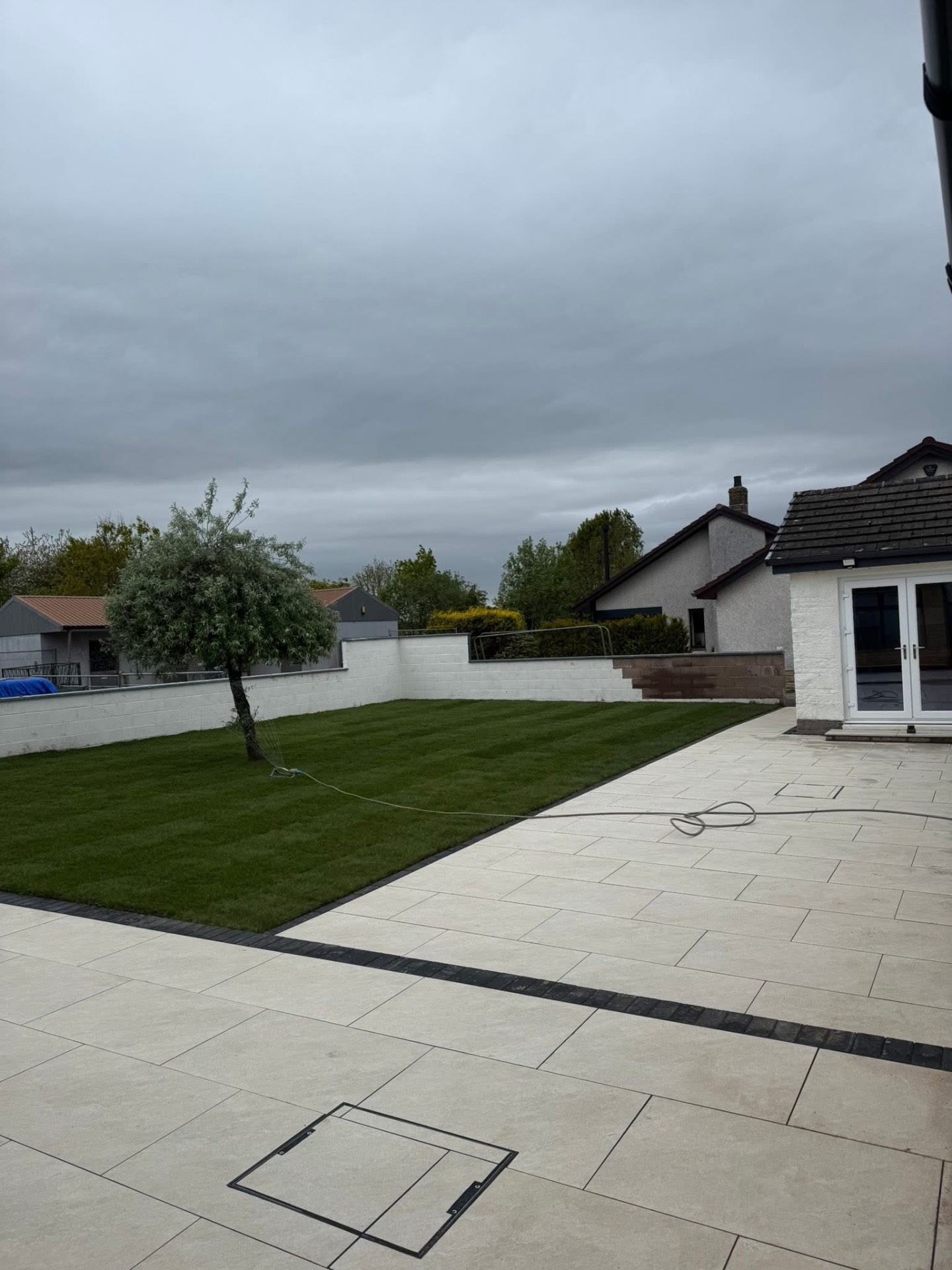
Porcelain (large-format) — £180–£260 per m²
Vitrified porcelain is the studio's most-installed paving and it's where porcelain paving cost sits at the top of the range. The slab itself is £40–£90 per m² depending on series, but the install is fussier than natural stone: cutting needs a wet saw with a porcelain blade, slabs need slurry priming on the back, and laying course tolerances are tighter. Worth it for the lifespan — 25+ years with effectively no maintenance — and for the finish, which doesn't fade.
Indian sandstone — £140–£190 per m²
The workhorse. £20–£35 per m² for the stone, easier to cut, more forgiving on tolerances. Calibrated sandstone (uniform thickness) installs faster than riven; riven looks more natural but takes longer to lay flat. Lifespan 15–25 years with periodic sealing.
Limestone — £150–£200 per m²
Tighter colour palette than sandstone, denser, sharper edges. Looks particularly good against modern render and timber cladding — which is why it's been the request on a lot of our 2024–2025 builds.
Granite setts and block paving — £130–£180 per m²
For driveways and detail courses. We use setts a lot as borders against porcelain — see the portfolio.
Resin overlays (over existing concrete) — £80–£140 per m²
Only viable where there's a sound concrete base. Cheap-looking when poorly specified.
What changes the price
Material is the line item people focus on. It's almost never the line item that decides the final figure. The five things that actually move the price:
Access. A site we can reverse a digger and grab lorry up to is a different job to one where everything walks through a side gate on a barrow. Add 15–25% for poor access.
Existing surface. Lifting old concrete (especially mesh-reinforced) is slow and noisy. Lifting old flags onto a new sub-base — quick. New build on turf — quickest.
Levels. A patio that needs to drop 200 mm across its length to meet an existing threshold is a different drawing to a flat slab. Falls have to be designed in at sub-base stage, not chased afterwards.
Drainage. If the patio sits within 5 m of the building and falls away from it, you'll likely need a linear drain or soakaway. £400–£900 added, depending on outlet route.
Ground conditions. In the Carlisle area, the topsoil is heavy compressible clay running 300–350 mm deep. It all comes out. On worse ground (peat, made ground, anything saturated) we'll specify a deeper sub-base or a geogrid — that's a survey conversation, not a quote adjustment.
Regional variation
Patio cost UK searches return mostly London-skewed figures — £200–£350 per m² is standard there. We sit roughly 15–25% below those numbers in Cumbria and the Borders. The reasons are mundane: labour rates, materials transport cost from the Yorkshire and Lancashire stone yards, and lower-priced disposal at our local tips.
Within our area, the price doesn't really change between Carlisle, Annan, Wetheral or Penrith. Cost of getting to the job is rolled into the day rate; nothing in our patch is more than 40 minutes from the yard.
Where the money actually goes
The slab is what people see. The sub-base is what makes the patio still look flat in 2040. Roughly half of any properly-built patio's installed cost is below the slab — the excavation, the Type 1, the compaction, the edge restraints. That's not where corners get cut on jobs we get called back to fix; it's where corners are always cut on jobs we get called back to fix.
If a quote comes in significantly below the ranges above, ask for the sub-base spec in writing. "MOT Type 1, 150 mm minimum, compacted in two layers, on a geotextile membrane" is the answer you want. "Hardcore" isn't.
Summary
For a quality patio installation in Cumbria, Carlisle, Annan or Dumfries in 2026, budget £140–£220 per m² installed for sandstone or limestone, or £180–£260 per m² for large-format porcelain. Anything materially cheaper is worth a second look at the spec; anything materially more expensive should come with a specific reason — access, levels, drainage, ground.
If you'd like a fixed written price for your space, we'll come and walk it. No obligation, no clipboard upsells. Site visits across Cumbria and Dumfries & Galloway.
Tell us about your space — we'll come and look.