Porcelain vs natural stone: which paving is right for your garden?
Two completely different materials with completely different lifespans. Here's how to choose between them properly.
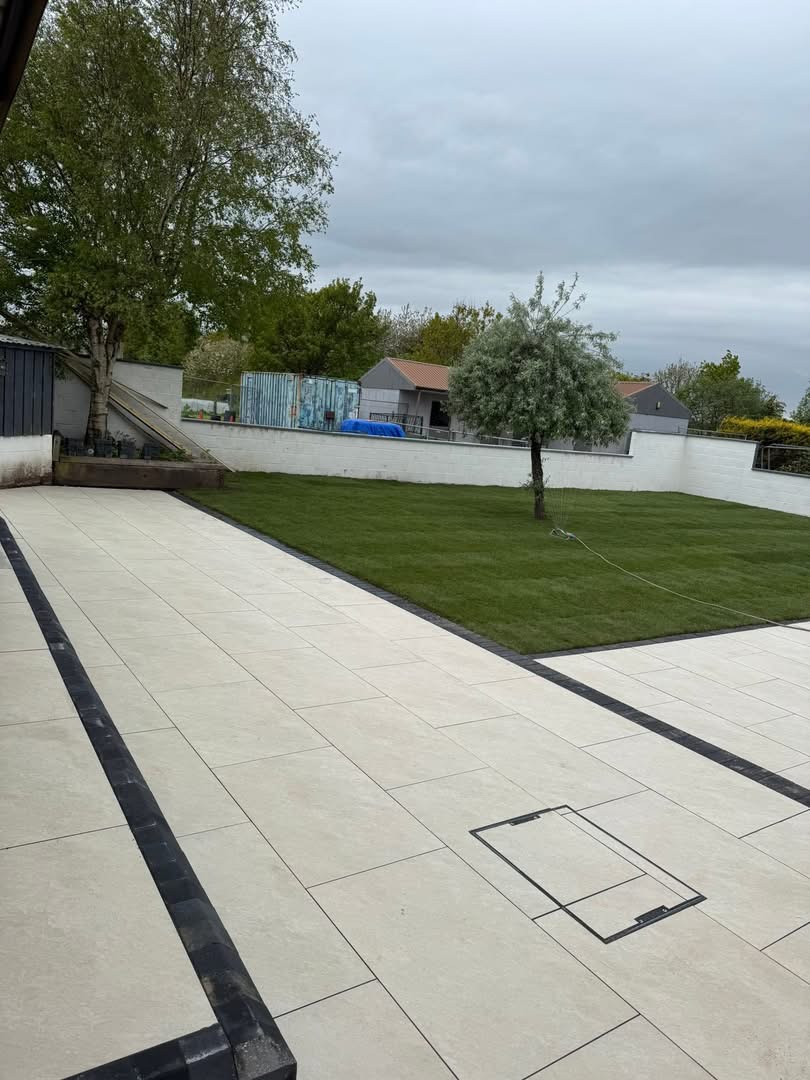
Two completely different materials
Porcelain and natural stone get sold side by side in every paving showroom in the country, which makes them feel like alternatives. They aren't. They behave differently, age differently, install differently and cost differently. Choosing between them isn't a style decision — it's a specification decision.
We install both. This is the version we'd give a friend.
What porcelain actually is
Porcelain paving is engineered. Clay, feldspar and silica fired at 1,200°C+ into a vitrified slab. The result is dense, non-porous, dimensionally uniform, and extremely hard. The colour and texture you see on the surface is printed and fired in — so a porcelain "sandstone" slab is a photographic impression of sandstone on a porcelain body.
The good bits:
- Doesn't absorb water (under 0.5% water absorption). No staining, no moss, no winter spalling.
- Doesn't fade. The pattern is fired in, not surface-applied.
- Razor-sharp factory edges — modern, architectural look.
- 20 mm slab thickness is standard, with a real-world lifespan of 25+ years on a properly built sub-base.
The catches:
- More expensive to install. Cutting needs a wet saw with a porcelain blade, and the slabs need slurry priming on the back for proper bond.
- Less forgiving on bedding tolerances. Twist a porcelain slab into a high spot and you've got a rocker — there's no give in the material.
- The riven-look options can look photocopied if specified cheaply. Spend on the slab, not on the showroom display.
What natural stone actually is
Quarried, sawn and finished from real rock — most commonly Indian sandstone, limestone and granite in the UK domestic market. Every slab is unique, with mineral variation, colour movement and (depending on the finish) tooled or riven texture.
The good bits:
- Looks lived-in from day one. Patina is part of the appeal.
- Forgiving to lay — variation in thickness and edge profile hides minor installation imperfections.
- Cheaper to buy and slightly cheaper to install than porcelain.
- Reads as traditional against stone-built and rendered Cumbrian homes — which is most of them.
The catches:
- Porous. Absorbs water, absorbs stain, hosts moss and algae in shaded areas. Sealing helps; sealing isn't permanent.
- Colours shift over time, especially the warmer sandstones. Some people love it; some don't.
- Indian sandstone in particular varies enormously by supplier. Cheap sandstone is genuinely cheap for a reason.
Side-by-side
| Factor | Porcelain (20 mm) | Indian sandstone (calibrated) |
|---|---|---|
| Installed cost | £180–£260 / m² | £140–£190 / m² |
| Lifespan | 25+ years | 15–25 years (with sealing) |
| Maintenance | Sweep and wash | Periodic seal, occasional scrub |
| Stain resistance | Excellent | Moderate |
| Frost resistance | Excellent | Good |
| Look | Modern, architectural | Traditional, characterful |
| Cutting difficulty | High (specialist kit) | Moderate |
| Edge profile | Sharp, factory | Sawn or riven |
When we recommend porcelain
- Modern or newly-rendered houses where sharp lines suit the architecture.
- Shaded gardens (north-facing, under tree canopy) where natural stone will go green within two seasons.
- Around pools, hot tubs and entertaining spaces — the stain resistance earns its keep.
- Anywhere the client wants to lay it and forget about it.
Roughly 60% of the patios we installed in 2024–2025 were porcelain. The trend's been one-way for the last five years.
When we recommend natural stone
- Older properties — sandstone-built farmhouses, traditional cottages — where porcelain reads as too clinical.
- Larger budgets going into character paving (premium sandstone, yorkstone, reclaimed flags) where the look earns the cost.
- Clients who actively want the patina, the weathering, the uniqueness-per-slab.
What the difference looks like in practice
Both materials installed properly will last 20+ years. Both will look good. The honest answer to "which is better" is "they're different products."
The mistake we see most often: people pick porcelain because they heard it's "the best", install it on a house and garden it doesn't suit visually, and end up with a finish that looks correct but cold. Or they pick the cheapest Indian sandstone and have a patio that's gone green and uneven inside five winters.
The cost of the slab is rarely the line item to optimise on. The cost of getting the wrong product for the setting is the one that hurts.
Summary
Porcelain: modern, low-maintenance, premium price, 25-year horizon. Natural stone: traditional, characterful, moderate maintenance, lower entry cost, replace-or-relay around year 20.
If you'd like to see both in person before deciding, we keep porcelain and sandstone samples in the van. Tell us about your space and we'll come and walk it.
Tell us about your space — we'll come and look.